BTS’ newest English single since last year’s DYNAMITE, was released on YouTube at midnight.
BUTTER 🧈 has been much anticipated globally by the BTS army 💜 worldwide. So much so that that there were 1.6 million people in que last night to view the release.
This post is a re-blog from Rolling Stone Magazine.
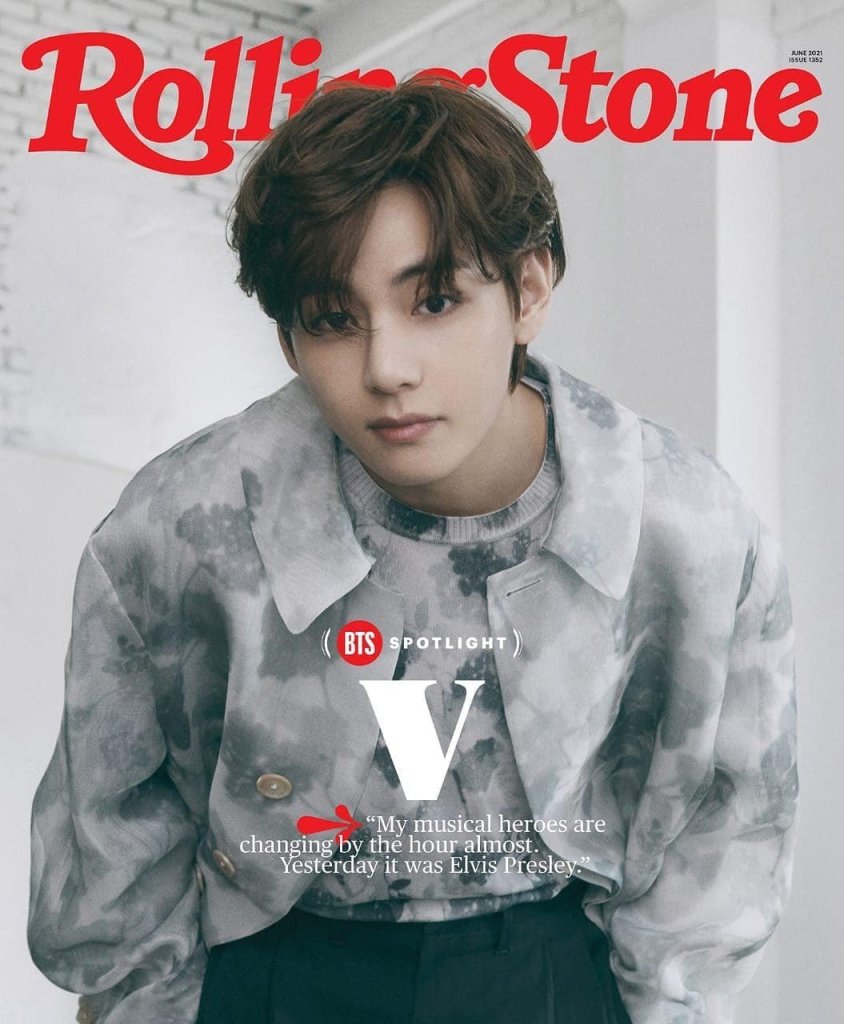
V of BTS, photographed in Seoul on April 6th, 2021.
BTS’ V on His Upcoming Mixtape, His Love of ‘The Godfather,’ and Being a ‘Secret Member’
“When they said I was a hidden member, I actually thought I’d been cut from the team,” V says
BRIAN HIATT
From the start, singer-songwriter-producer V was BTS’ secret weapon. His rich, deep voice is a pleasing contrast to his fellow singers’ ever-higher high notes, and he’s not afraid to delve into full-on bedroom R&B, as on the downright sultry neo-soul track “Intro: Singularity.” With a love of jazz and classical music, V began his musical life as a saxophone player, and has the most eclectic list of influences of any member of BTS, from Sammy Davis Jr. to Sam Cooke to Coldplay (BTS’ recent cover of “Fix You” was apparently his idea). Wearing a black newsboy-style hat, a zipped-up black parka, and a white mask in his label’s headquarters one morning in April, he sipped orange juice and talked about his upcoming mixtape, his Elvis Presley fandom, his favorite movies, and more.
I know yesterday you did a variety show for the first time in a long time. How was that? It was our first appearance in five years. So I was really nervous and I was really tense. So I didn’t get a lot of sleep. But then actually when we showed up yesterday for the actual shoot, the host of the program was really kind and really accommodating. So everything went really well. I felt really comfortable. And then this morning, because of our interview, I also didn’t get a lot of sleep last night.
I’m sorry about that! [Laughs] No, no, no, no, no.
I know you had been working very hard on your mixtape, and it’s been delayed, and I think you feel a lot of pressure to make it right. How’s it going now? We’ve worked and made music as a group, and as a group only. So working on my own tape means that I have to do everything related to all the songs on the album. I have to take part in writing the lyrics and the melodies for all the songs and the production process. So, it is a bit of a pressure to bear all of the load that is distributed among the other members for a group album. So it is tough. But what is good about it is it gives me an opportunity to show who I am, and show the music that really has the color of Kim Taehyung, the color of V, to our ARMY. So that’s great opportunity of course, and that’s what makes creating this mixtape so much fun and fulfilling.
So, what is your current prediction for when you will put it out? I originally thought of releasing it last year. But it turned out to be more harder and more complex than I imagined that it would be. So then I thought I would release it early this year. But again, it turned out to be a bit more tough than I thought it would be! So now I’m looking at the end of this year.
You already had the solo song “Sweet Night,” from a TV soundtrack. What did you take away from the experience of making that? That was released as part of a soundtrack for someone I knew really well [actor and former cast-mate Park Seo-joon]. but it was actually originally made as part of my mixtape. It’s one of my personal songs. That song started out from me feeling that I really wanted a good night’s sleep.
“Blue and Gray” is a gorgeous song. You said you wrote it about a time when work was really hard for you and you weren’t happy. What was it about the work that was hard? That was when the Covid pandemic was just really expanding and becoming serious. We had prepared really hard to show ARMY our “On” performances. And what I was finding difficult at the time was not being able to show what we practiced and prepared so hard. I was telling all ARMY on social media, “Get ready, we’re about to show you these great performances!” So that was really frustrating and difficult and it made me sad. I think there was a measure of being tired and really sort of burned out a little bit from the work as well.
Were there any good points of this year off the road? It allowed me to really focus on something. Pre-Covid, I was so busy that I couldn’t really concentrate on one thing or really focus on something new. If I wanted to do a new thing, I was really forced to sort of be a dilettante. I couldn’t dive deep. But during the last year I had more time. In my work, I really tried to do more producing and then go more in-depth on my music. My melodies before were not that complex, or intricate, I thought. But I was able to focus more energy into it, to listen to more music, and really sort of think about more things. And that, I think, helped me to really dive into the producing aspect of making music. And I had a lot of time to come up with good melodies, and also had a lot of time to just sort of sit and vegetate. [Laughs] And that also helped me.
I know that you like many different kinds of music. Tell me about some of your musical heroes. My musical heroes are constantly changing by the hour almost. So yesterday, you know, it was Elvis Presley. And today might be somebody else. This is sort of my personal preference, but I think I like the older Elvis Presley, the Elvis Presley of his later years. There are many famous Elvis songs, but I feel like there’s a lot of songs that are more hidden, and not as prominent in the song discography. So, what I’m trying to do, and what I want to do, is listen to every single song, even if it’s just one minute of the song. Both the big songs and even the songs that are sort of hidden among the tracks.
There’s some great 1950s ones as well, but you’re right, late-period songs like “Kentucky Rain” and “Suspicious Minds” are some of his best. If you can recommend some must-listen Elvis Presley songs, I’ll listen to them!
I’ll get a playlist to you. So what was it like to be a “secret member” before BTS’ debut? To be perfectly, perfectly honest, when they said I was a hidden member, I actually thought I’d been cut from the team.
So can you laugh about that now or is it still a little bit traumatic? I can laugh about it now for sure. As long as I can sort of toss around our CEO, our label’s boss, and shake him around a little bit by his cuffs. But yes, I can laugh about it.
I’ve heard you like old movies. What are some of your favorites? I like old movies, but also movies that are classics but not super old. Like for example, The Godfather was a movie that I really enjoyed. And Reservoir Dogs is one of my all-time favorite movies. The Godfather I actually watched recently. A friend of mine had told me, “It’s really long, I fell asleep in the middle of it.” And I thought, “Is it that boring?” And then I watched it and I was really moved by it, especially the charisma of the godfather [Marlon Brando], and all the actors and the direction and the production. And again, his charisma, and his commanding presence during the film
You did some acting of your own in the TV drama Hwarang. Do you want to do more of that going forward? It’s something that I’m thinking about after I turn 30.
Suga on How BTS Stay Hungry After Conquering the World by Brian Hiatt
This post is a re-blog of the Original Interview.
“I do sometimes think, ‘Why did I have to spend so much time in the studio?’” says Suga
With his biting, confessional lyrics, technique-heavy flow that can hit Busta Rhymes-like levels of emotional intensity, extensive production and songwriting credits, and indomitable work ethic, Suga is an indispensable piece of BTS’ collective artistic soul. In April, he sat in his label’s headquarters, wearing a gray knit cap, white mask, and black parka as he spoke about his battles with depression, his songwriting process, staying hungry after conquering the world, and much more.
You had surgery late last year for a shoulder injury that I believe dates back to your trainee days. How are you feeling?
Much better. There’s still some physical therapy that I have to do, but it’s much better. And, yes, I suffered the injury in an accident when I was 20 years old and then as I continued to deteriorate, it was recommended to me that I undergo surgery. Fortunately, there was a little bit of time that I could use to have this procedure. So that’s what we did.
It’s very impressive that you’ve been doing elaborate choreography for all these years with this injury. How did you manage that?
By the year before I got the surgery, I think, I was receiving treatment, injections, almost on a monthly basis. But there were times when I couldn’t lift my arms or have a full range of motion in the middle of a concert. So it wasn’t really so much about the pain. It’s more about whether I would be able to continue doing these performances. When you are actually performing, because of the adrenaline and whatever, it doesn’t really hurt. You sort of experience that the next day, that’s when you feel the pain or the discomfort or you can’t raise your arms anymore.
I love the song “First Love,” where you talk about your early infatuation with your piano and with music. The lyrics suggest that your love for music is also a source of torment; what was going on there?
When I was working on “First Love,” I wanted to express a mix of different emotions, because first love is not all good things; there’s the bitter things as well. So I was talking to Mr. Bang about attaching the metaphor of first love to the first moment I came to know music. The target of the love is a piano, but it could be anything – a friend, some other entity. Then, I wanted to show the emotions you go through.
You’ve been open in your lyrics about depression and other struggles. How are you now?
I’m comfortable now and feeling good, but those sorts of negative emotions come and go. So it’s almost like cold weather. It may come back in a cycle over a year, year and a half. But when I hear people say that when they listen to my music, and feel comfort and are consoled by those lyrics that express these emotions, that makes me feel very good. It’s very encouraging. I think, for anybody, these emotions are not something that need to be hidden. They need to be discussed and expressed. Whatever emotions that I may be feeling, I’m always ready to express them now, as I was before.
You’ve written many songs for BTS, many songs for yourself, and many songs for other people. What is your usual songwriting process?
The process is really different for every song. Sometimes it may be a word that pops up and I build on that word, or someone could make a request for a certain way they would like a song to be developed. Oftentimes, we decide on a theme and then we sort of freely work from the larger overarching theme that we may have. But generally, when I work on a song, I create the beat first and then the melody and the rap and then finally the lyrics. That’s generally how I build them.
How is your guitar playing going?
Since my shoulder got much better, I am back on the guitar. I’ve been playing other people’s songs to practice, of course, and I’m looking forward to sometime in the far future of being able to sing and play the guitar at the same time. That’s what I’m working toward.
On “Dope,” you have a great line about your youth rotting in the studio. But do you ever have regrets about that?
I have no regrets about the work in the studio. Those days and that time has allowed me to have the kind of opportunities that I have now and today. So there’s no regret. But I do sometimes think, “Why did I have to spend so much time in the studio?” [laughs] Why couldn’t I have gone faster. I had that head-to-the-grindstone effort. Why couldn’t I have rested a little more or refreshed myself a little bit more? I do think about that.
You and RM and J-Hope have all these great double and triple entendres and other wordplay that can be lost on listeners who don’t speak Korean — translations can’t convey all of it. Is it frustrating that some of your foreign fans might miss certain things?
When I was growing up, of course, I listened to American hip-hop and pop, and my English is not very good. So I read the lyrics and the translations of the lyrics. And obviously, what native speakers of English may consider the key lines, the key verses, the punchlines, I really couldn’t understand them because of the intricacies of the language. And, I think, that’s an unavoidable part of the language barrier. And, I think, it’s important to try to find a happy medium where people from both languages and cultures or other languages understand it. So we try to write lyrics sort of in the happy middle, that can be understood by people speaking other languages. And also, I’m studying English more and more, trying to get more familiar with it. So if we can get both Korean speakers and English speakers to understand the lyrics, that would be great. But again, that’s something I experience as well.
There’s a story that your parents didn’t like that you were rapping, that they even tore up your lyrics. How did that affect you?
My parents didn’t understand rap. They are a generation apart from myself, and they never listened to rap; it wasn’t part of the music that they listened to. So it’s only natural they were against what I was doing. And, of course, being a musician is a very unstable profession as well. So I can understand perfectly why my parents were against what I was doing. But I think that motivated me or helped me work harder because there was something that I now had to prove. I had to show my parents it was possible. So it drove and motivated me to work even harder.
After all that BTS has achieved, how do you stay hungry?
I’m one of those people who think that not only do people change, but people must change. But I do think it’s so important to maintain that hunger. But from the days when we were actually hungry, we set routines for ourselves, and they stay with you, even if you change as a person. I think we are still able to draw upon the things that we talked about when we were still hungry, so we can maintain that work ethic and stay hungry, even if we change and develop as people. Now, instead of hungry, I think we’re more hangry! Angry and hungry [laughs].




 Cup A Noodle Geek