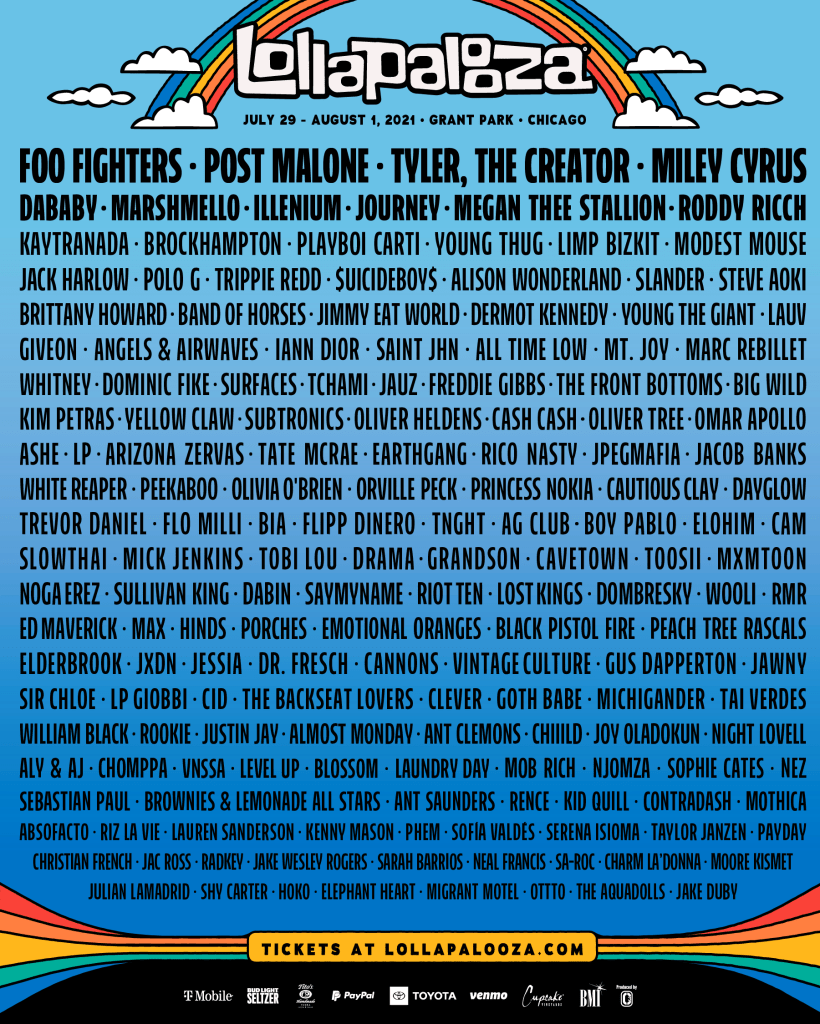
This week Chicago Mayor Lori Lightfoot announced the Lollapalooza festival’s return on Tuesday. In a tweet, she said, “In alignment with our public health guidance, the world class festival returns to the city later this summer. However, full COVID-19 vaccination or a negative test will be required to enjoy the festivities.” The tweet included a video in which Lightfoot claims to like the rapper Polo G, and calls up Lolla founder Perry Farrell in a skit of sorts.
Headlining the summer music festival will be the Foo Fighters, Post Malone, Tyler, the Creator and Miley Cyrus. And the fest will be at full capacity, too.
Other recent music festival announcements have been for punk festival Riot Fest and Pitchfork Music Festival Chicago.
Lineup may change at anytime
Current Health Policy
In accordance with current local public health guidance, full COVID-19 vaccination or negative COVID-19 test results will be required to attend Lollapalooza 2021. For patrons who are not fully vaccinated, a negative COVID-19 test result must be obtained within 24 hours of attending Lollapalooza each day. Details on the festival entry process will be available in early July. If you have questions about COVID-19 vaccines or to find a vaccination location near you, please visit www.vaccinefinder.org.
COVID-19 Warning
We have taken enhanced health and safety measures for you, our artists and employees. You must follow all posted instructions while attending Lollapalooza.
An inherent risk of exposure to COVID-19 exists in any public space where people are present. COVID-19 is an extremely contagious disease that can lead to severe illness and death. According to the Centers For Disease Control and Prevention, senior citizens and guests with underlying medical conditions are especially vulnerable.
By attending Lollapalooza, you voluntarily assume all risks related to exposure to COVID-19.
Suga on How BTS Stay Hungry After Conquering the World by Brian Hiatt
This post is a re-blog of the Original Interview.
“I do sometimes think, ‘Why did I have to spend so much time in the studio?’” says Suga
With his biting, confessional lyrics, technique-heavy flow that can hit Busta Rhymes-like levels of emotional intensity, extensive production and songwriting credits, and indomitable work ethic, Suga is an indispensable piece of BTS’ collective artistic soul. In April, he sat in his label’s headquarters, wearing a gray knit cap, white mask, and black parka as he spoke about his battles with depression, his songwriting process, staying hungry after conquering the world, and much more.
You had surgery late last year for a shoulder injury that I believe dates back to your trainee days. How are you feeling?
Much better. There’s still some physical therapy that I have to do, but it’s much better. And, yes, I suffered the injury in an accident when I was 20 years old and then as I continued to deteriorate, it was recommended to me that I undergo surgery. Fortunately, there was a little bit of time that I could use to have this procedure. So that’s what we did.
It’s very impressive that you’ve been doing elaborate choreography for all these years with this injury. How did you manage that?
By the year before I got the surgery, I think, I was receiving treatment, injections, almost on a monthly basis. But there were times when I couldn’t lift my arms or have a full range of motion in the middle of a concert. So it wasn’t really so much about the pain. It’s more about whether I would be able to continue doing these performances. When you are actually performing, because of the adrenaline and whatever, it doesn’t really hurt. You sort of experience that the next day, that’s when you feel the pain or the discomfort or you can’t raise your arms anymore.
I love the song “First Love,” where you talk about your early infatuation with your piano and with music. The lyrics suggest that your love for music is also a source of torment; what was going on there?
When I was working on “First Love,” I wanted to express a mix of different emotions, because first love is not all good things; there’s the bitter things as well. So I was talking to Mr. Bang about attaching the metaphor of first love to the first moment I came to know music. The target of the love is a piano, but it could be anything – a friend, some other entity. Then, I wanted to show the emotions you go through.
You’ve been open in your lyrics about depression and other struggles. How are you now?
I’m comfortable now and feeling good, but those sorts of negative emotions come and go. So it’s almost like cold weather. It may come back in a cycle over a year, year and a half. But when I hear people say that when they listen to my music, and feel comfort and are consoled by those lyrics that express these emotions, that makes me feel very good. It’s very encouraging. I think, for anybody, these emotions are not something that need to be hidden. They need to be discussed and expressed. Whatever emotions that I may be feeling, I’m always ready to express them now, as I was before.
You’ve written many songs for BTS, many songs for yourself, and many songs for other people. What is your usual songwriting process?
The process is really different for every song. Sometimes it may be a word that pops up and I build on that word, or someone could make a request for a certain way they would like a song to be developed. Oftentimes, we decide on a theme and then we sort of freely work from the larger overarching theme that we may have. But generally, when I work on a song, I create the beat first and then the melody and the rap and then finally the lyrics. That’s generally how I build them.
How is your guitar playing going?
Since my shoulder got much better, I am back on the guitar. I’ve been playing other people’s songs to practice, of course, and I’m looking forward to sometime in the far future of being able to sing and play the guitar at the same time. That’s what I’m working toward.
On “Dope,” you have a great line about your youth rotting in the studio. But do you ever have regrets about that?
I have no regrets about the work in the studio. Those days and that time has allowed me to have the kind of opportunities that I have now and today. So there’s no regret. But I do sometimes think, “Why did I have to spend so much time in the studio?” [laughs] Why couldn’t I have gone faster. I had that head-to-the-grindstone effort. Why couldn’t I have rested a little more or refreshed myself a little bit more? I do think about that.
You and RM and J-Hope have all these great double and triple entendres and other wordplay that can be lost on listeners who don’t speak Korean — translations can’t convey all of it. Is it frustrating that some of your foreign fans might miss certain things?
When I was growing up, of course, I listened to American hip-hop and pop, and my English is not very good. So I read the lyrics and the translations of the lyrics. And obviously, what native speakers of English may consider the key lines, the key verses, the punchlines, I really couldn’t understand them because of the intricacies of the language. And, I think, that’s an unavoidable part of the language barrier. And, I think, it’s important to try to find a happy medium where people from both languages and cultures or other languages understand it. So we try to write lyrics sort of in the happy middle, that can be understood by people speaking other languages. And also, I’m studying English more and more, trying to get more familiar with it. So if we can get both Korean speakers and English speakers to understand the lyrics, that would be great. But again, that’s something I experience as well.
There’s a story that your parents didn’t like that you were rapping, that they even tore up your lyrics. How did that affect you?
My parents didn’t understand rap. They are a generation apart from myself, and they never listened to rap; it wasn’t part of the music that they listened to. So it’s only natural they were against what I was doing. And, of course, being a musician is a very unstable profession as well. So I can understand perfectly why my parents were against what I was doing. But I think that motivated me or helped me work harder because there was something that I now had to prove. I had to show my parents it was possible. So it drove and motivated me to work even harder.
After all that BTS has achieved, how do you stay hungry?
I’m one of those people who think that not only do people change, but people must change. But I do think it’s so important to maintain that hunger. But from the days when we were actually hungry, we set routines for ourselves, and they stay with you, even if you change as a person. I think we are still able to draw upon the things that we talked about when we were still hungry, so we can maintain that work ethic and stay hungry, even if we change and develop as people. Now, instead of hungry, I think we’re more hangry! Angry and hungry [laughs].
Yesterday after the release of the Rolling Stone cover story RM was trending globally. Below you’ll find the Rolling Stone Cover Interview of RM by Brian Hiatt.
A Deep Conversation with BTS’ RM on His Group’s Early Years, Drake, Whether BTS Is K-Pop, and More
“I had a sense of urgency and desperation about going after my dreams,” says BTS’ leader
“I was someone who wanted to go to a top college, an Ivy League school by American standards,” says RM, BTS’ leader. “I was a typical student who was trying hard to achieve. And then I trusted [HYBE founder] Mr. Bang, and I started to walk down a different path. And I had a sense of urgency and desperation about going after my dreams.” RM’s gifts as a rapper, songwriter, and producer have been essential to BTS’s development, as have his wide-ranging intellectual interests. In an interview from his label’s headquarters, the artist formerly known as Rap Monster discussed whether BTS should be considered K-pop, the uniqueness of South Korean hip-hop, the highlights of the Most Beautiful Moment in Life era, and more.
In his words: “Everything that we do, our existence itself, is contributing to the hope of leaving xenophobia behind”
You quoted the great abstract artist Kim Whan-Ki : ‘ I’m Korean, and i cant do anything apart from this, because I am an outsider.” You said that was a key thing you’ve been thinking about lately. How does that idea apply to your work?
So much of the pop and hip-hop I listened to came from America. But for me , as a Korean , I think we have our own characteristics and some kind of localized identity. I cant really explain it very well, but there are some characteristics that we Koreans have, or maybe Eastern people. Sp we try to kind of combine those two things into one and I feel that we created a new genre. Some may call it K-pop, some may call it BTS, or some Eastern-Western combined music, but I think that’s what we’re doing. If you think about the Silk Road in the past, there’s this idea of Eastern people and Western people meeting on some kind of, like, big road and maybe doing selling and buying of stuff. I think this story repeats itself, and some kind of new, interesting phenomenon is happening. We feel very honored to be existing in the very eye of this big hurricane.
When BTS first started, there was this conflict in some people’s minds and in your own between the idea of being a rapper, or being an idol, which we’d call a pop star. This is obviously something you’ve addressed in song. Maybe you can explain a little about the conflict and why it seemed so important at the time?
When I was young, I wanted to be a writer of prose and poetry, and then I found rap. And a lot of what I wanted to do went into music. And, yes, there was this idea of being a pure artist or a pure rapper. So in the beginning it is true that when we were debuting as a pop act, there were times when I had to sort of reorganize my identity and then reflect on what my identity is. and at the beginning we didn’t see the positive results. We didn’t have a lot of fans. We didn’t have great results . There were some times when we were mocked. So it is true that it took some time for that identity to develop and settle itself. But, you know , whether it’s rap or pop music, or whatever it is, it is another method for me to show my mind and express my voice, and having that resonate with people. So a lot of that conflict resolved itself. And I think things today are very different from they were like in 2013, because even though there’s still a lot of discussion about what is pure, what is authentic, what is sincere, what’s an artist, what’s a pop musician, those boundaries have become less and less meaningful. As long as I can show what I’ve written, it’s valid as the continuation of my dream and what I’ve always wanted to do.
There’s so much great Korean hip-hop, including your early heroes Epik High, who are still active. What did you hear in it early on, and what do you hear in it now?
There’s a;ways the process of when something new come into another culture, where the identity gets transformed and it changes and adapts to this new place. Obviously, there are differences between Korea and the United States that affect the music. For example, Korea is not a multi ethnic country like the United States. So there are different sensitivities that are underlying the music. Korean rappers of course have their own unique and different lyricism, their own situations and hardships that they fit into the process. As a Korean, obviously, these are the things that resonate with me.
Obviously, there’s a saying there’s nothing new under the sun. So especially for people like us, in the margins of the world, so to speak, we think about how can we transform this and how we can make this our own. So these are the things that I think about when I try to balance the inspiration of Korean and American rappers. And, I think, now though, there’s a convergence of all genres of music.
It feels like BTS really found itself around the time of Most Beautiful Moment of Life. That’s where everything came together. How do you look back at that time?
Despite the name, Most Beautiful Moment of Life, that was actually a very tumultuous period for me and for us. There was the tough image we had in 2 Kool 4 skool, in those early stages, a sort of exaggerated expression of toughness and that angst. And then we sort of slowed down a little bit and tried to express the emotions of young people who have really nothing more the dreams. It was a more honest sort of expression, and we witnessed how it was resonating with a lot of people. There was some confusion because this was something new, and we were showing ourselves to be more vulnerable, more delicate, which was very different. But we realized that it was meaningful, and as we went forward to the Love Yourself series, we started to discover that more and more as we continued.
I know that many fans don’t see BTS as part of K-pop.And you yourselves , have said that “BTS is the genre.” How do you see it?
That’s a very important debate. Because what they call K-pop, that genre is expanding very fast.For example some so-called K-pop groups have only foreigners , from Europe, India, China, like, everywhere. There are no Korean members, but they do the K-pop thing, they’re switching the parts, and so on. BTS is expanding very fast as well. And K-pop is now so wide. Somebody could say that K-pop is for Koreans who sing Korean song. That could be K-pop. But what about “Dynamite”? We sing the song in English. But we’re all Koreans, so somebody may say it’s a K-pop song. Or they may say it’s just a pop song, because it’s in English. But we don’t actually really care about whether people see us inside or outside K-pop. The important fact is that we’re all Koreans, and we’re singing a pop song. So that’s the reason why we said that our genre is just BTS. That debate is very important for the music industry, but it doesn’t mean very much for us members.
What music really changed your idea of what’s artistically possible?
I started with Nas, Eminem the golden age of hip-hop. And the turning point was Drake, in 2009, when he released Thank You Later. That album was kind of shocking for me because it was kind of a freaky thing that a rapper actually sang. So after that a lot of rappers began to sing, deciding to put the melodies into their song across the genres, between the raps and melody. So, yeah, that was the moment.
When you rapped that your “shadow…is called hesitation,” what did you mean by that?
It can be called hesitation or cautiousness, but, I think, there is a form of hesitation that prevents you from taking risks and prevents you from challenging yourself.
I know you motivated the members by saying that your grandkids might watch your Grammys performance someday. Is that something you think about often?
It gives me lots of goosebumps sometimes that our every moment leaves traces online where everyone can see them. So, yeah, I think that helps us keep motivated .
Some film actors have a saying, “Pain is temporary. Film is forever” [Nods.] Lie is short. Art is forever.



 Cup A Noodle Geek